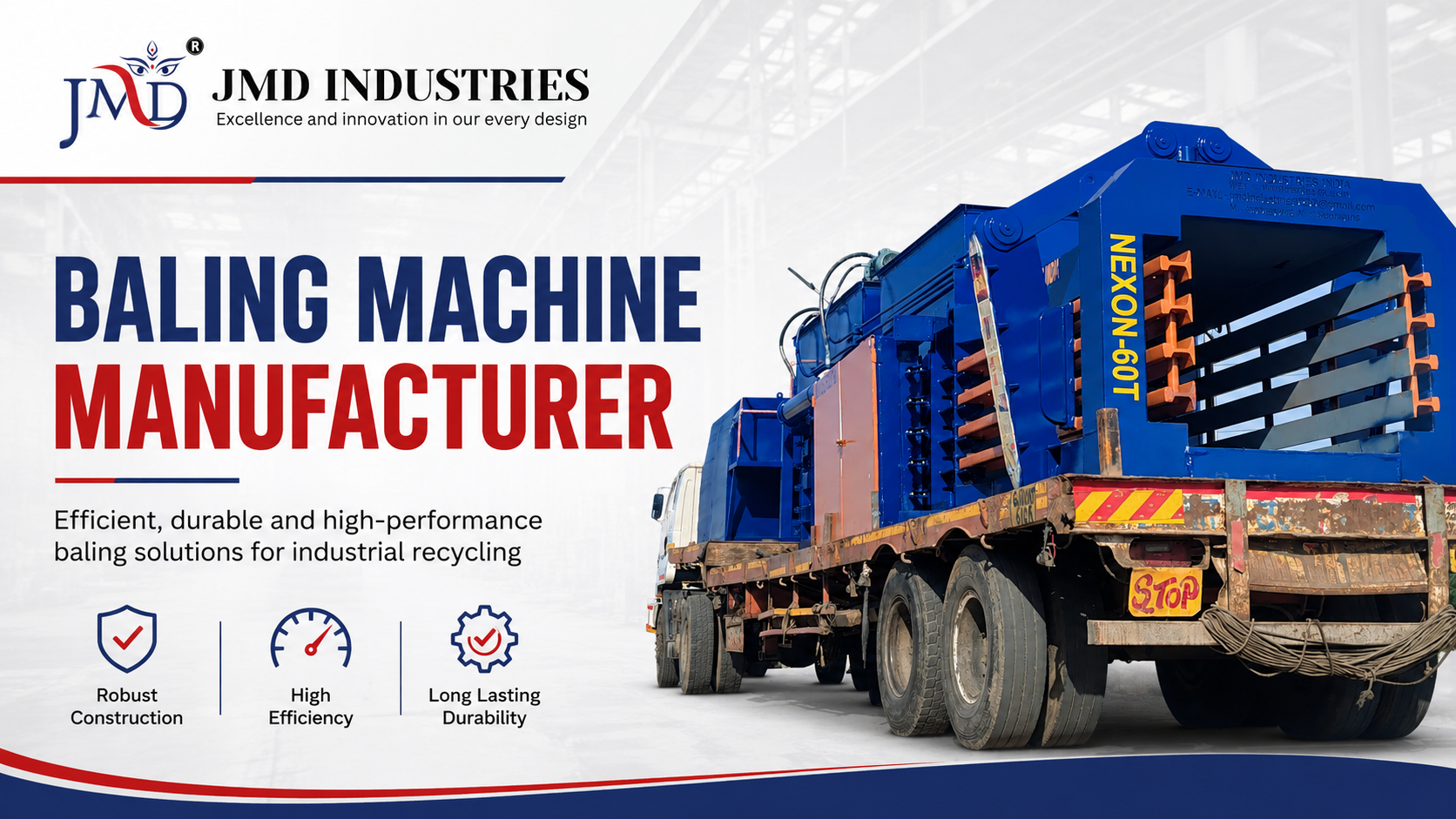


Industrial waste management has become an important part of modern manufacturing, recycling, warehousing, and material handling operations. Industries that generate paper, cardboard, plastic, metal scrap, packaging waste, and other recyclable materials need a reliable system to collect, compress, store, and move these materials in an organized way. A baling machine plays a key role in this process by converting loose waste materials into compact, manageable bales that are easier to handle, stack, transport, and recycle.
JMD Industries offers baling machines designed to support industrial waste management with durability, automation, and operational efficiency. As a baling machine manufacturer, the company focuses on practical machinery solutions that help businesses reduce manual handling, improve workflow, and manage recyclable materials more effectively. These machines are suitable for facilities that handle large volumes of waste and require consistent bale formation for smooth storage and transportation.
A high-quality baling machine is not only useful for waste compression but also for improving overall workplace organization. Loose waste materials take up more space, create handling challenges, and may affect productivity in industrial environments. By compressing these materials into dense bales, companies can optimize storage space, reduce clutter, and improve internal material movement. This makes baling machines a valuable choice for recycling centers, manufacturing units, warehouses, logistics facilities, packaging companies, and scrap processing operations.
JMD Industries designs balers that are suitable for materials such as paper, cardboard, plastics, and metals. These machines are built with strong construction, reliable hydraulic systems, user-friendly controls, and safety-focused features. With automation and efficient performance, they help industries maintain continuous operations while reducing labor dependency and operational downtime.
Automation is one of the most important advantages of modern baling machines. In industrial environments where large volumes of recyclable materials are generated every day, manual compression and handling can be time-consuming, labor-intensive, and inconsistent. JMD Industries’ balers are designed to improve workflow efficiency by automating key processes such as feeding, compression, tying, and bale ejection.
A fully automated or semi-automated baling system reduces the need for constant manual intervention. Once the material is fed into the machine, the baler compresses it into a compact bale with consistent pressure. Depending on the machine design, tying and ejection can also be handled automatically, which supports faster processing and reduces operator workload. This type of automation helps facilities manage waste more systematically and maintain a steady production or recycling flow.
User-friendly control panels make the machine easier to operate. Operators can monitor machine performance, adjust settings, and manage the baling process with better control. This is especially useful for recycling centers, warehouses, and manufacturing units where different types of materials may need different compression settings. A simple and clear control interface helps reduce operational errors and improves safety during machine use.
Efficient workflow also depends on reducing bottlenecks. When loose waste materials are not processed on time, they can occupy valuable floor space and disrupt movement within the facility. A reliable baling machine helps prevent this issue by continuously converting bulky materials into compact bales. This allows staff to maintain a cleaner, more organized working area and ensures smoother movement of goods, equipment, and recyclable materials.
For industries that process large quantities of waste, automation also supports productivity. Workers can focus on monitoring, sorting, and managing operations instead of spending excessive time on manual compaction or handling. As a result, the facility can achieve better output with improved consistency and lower dependency on repeated manual effort.
Industrial machinery must be built to handle demanding working conditions. Baling machines are often used in environments where materials are heavy, bulky, irregular, or abrasive. For this reason, strong construction and long-term reliability are essential. JMD Industries manufactures baling machines with robust steel frameworks and precision-engineered components to support heavy-duty industrial applications.
The structural strength of a baling machine directly affects its performance and service life. A durable frame helps the machine withstand repeated compression cycles without losing stability. The hydraulic system, compression chamber, feeding mechanism, and tying system must work together smoothly to produce consistent bales. Strong engineering helps reduce vibration, wear, and mechanical stress during operation.
Compact design is another important factor in industrial construction. Many facilities have limited floor space, and machinery must be installed in a way that supports smooth movement and safe operation. A well-designed baler helps maximize available space while still providing efficient processing capacity. This makes it suitable for warehouses, recycling units, manufacturing plants, and scrap handling facilities.
Energy efficiency is also a key part of modern machinery design. A baling machine that delivers reliable compression with optimized energy usage helps reduce operational costs over time. Since waste processing may be a daily activity in many industries, even small improvements in energy efficiency can contribute to better long-term value.
Durable construction also simplifies maintenance. Machines designed with easy access to critical components allow maintenance teams to inspect, clean, lubricate, and service the equipment more efficiently. This reduces downtime and helps extend machine life. For industrial users, a machine that is easy to maintain is often more practical and cost-effective than one that requires complicated servicing.
Baling machines are used across many industries because recyclable waste is generated in different forms and volumes. Whether the material is paper, cardboard, plastic, metal, or packaging waste, a baler helps convert it into compact bales for easier handling. JMD Industries’ baling machines are suitable for various industrial applications where organized waste management is required.
Recycling centers are one of the most common users of baling machines. These facilities handle large quantities of recyclable materials collected from commercial, industrial, and municipal sources. Paper, cardboard, plastic bottles, plastic films, and mixed recyclables can take up significant space if left loose. Baling machines help recycling centers compress these materials into uniform bales, making storage and transport more efficient.
Manufacturing units also benefit from baling machines. Many factories generate continuous waste streams from raw materials, packaging, production trimming, plastic scrap, metal offcuts, and rejected materials. Instead of allowing waste to accumulate, a baler helps compress it regularly and keep the production area clean. This supports better housekeeping, safer movement, and more efficient waste disposal or recycling.
Warehouses and distribution centers often generate large amounts of packaging waste, especially cardboard, shrink wrap, plastic straps, and cartons. A baling machine helps these facilities manage waste without occupying too much storage space. Compact bales can be stacked neatly and moved easily, improving internal logistics and reducing clutter.
Metal and scrap processing operations require strong baling equipment capable of handling heavier materials. Metal scrap can be difficult to store and transport in loose form. Baling machines help compress scrap into dense bales, which can be handled more safely and efficiently. This makes the machine useful for scrap yards, metal recycling units, and industrial workshops.
Packaging industries, printing units, textile units, logistics companies, retail distribution hubs, and plastic processing plants can also use baling machines to improve waste management. The ability to handle different material types makes the machine a versatile solution for many business environments.
A reliable baling machine must offer a combination of strength, efficiency, ease of use, and safety. JMD Industries’ balers are designed with features that support industrial performance and long-term value. These features help users process recyclable materials more efficiently while maintaining consistent bale quality.
Together, these features help improve workflow efficiency, reduce labor requirements, support cleaner operations, and make recyclable material management more organized.
Regular maintenance is necessary to keep a baling machine performing efficiently. Like any industrial equipment, a baler works under pressure and handles different types of materials, which makes routine inspection important. Proper maintenance helps avoid breakdowns, extends machine life, and ensures consistent bale quality.
Choosing the right baling machine depends on the type of material, processing volume, available space, and operational requirements. Not every facility needs the same machine, so careful selection helps ensure better performance and long-term value.
Sustainable waste management is becoming increasingly important for industrial businesses. Companies are expected to reduce waste, improve recycling, and operate responsibly. A baling machine supports these goals by making recyclable material handling more efficient and organized.
When waste materials are left loose, they occupy more space and require more frequent movement. By compacting materials into dense bales, a baling machine reduces storage requirements. This allows facilities to use available space more effectively and maintain cleaner working areas.
Transportation efficiency also improves with baling. Compact bales can be loaded more easily and transported in larger quantities compared to loose waste. This can reduce the number of trips required for material movement, which may help lower fuel usage and transportation-related emissions.
Energy-efficient baling machines also contribute to sustainable operations. Machines designed to optimize power consumption help reduce electricity use while maintaining strong performance. This supports both environmental responsibility and operational cost control.
Baling also improves recycling value. Uniform bales are easier for recyclers to handle, sort, store, and process. This encourages better recycling practices and supports circular material use. For industries working with paper, cardboard, plastics, and metals, proper baling helps ensure that recyclable materials are managed professionally rather than wasted.
By investing in baling equipment, companies can support cleaner operations, reduce waste accumulation, and contribute to better environmental management. This is especially important for industrial facilities that want to align with responsible business practices and long-term sustainability goals.
A baling machine becomes even more effective when it is properly integrated with other material handling systems. JMD Industries’ balers can work with conveyors, shredders, and related handling equipment to improve overall workflow. This integration is useful for facilities that process continuous material streams.
Conveyors help move materials directly to the baler, reducing manual lifting and carrying. This improves safety and saves time, especially when materials are bulky or generated in large quantities. A conveyor-fed baling system can maintain a steady flow of material into the machine.
Shredders can be used before baling when materials need size reduction. Some plastics, paper products, or scrap materials may be easier to compress after shredding. When shredders and balers work together, the final bale can become more uniform and manageable.
Material handling integration reduces bottlenecks in the facility. Instead of collecting waste manually and feeding it in batches, automated systems can move material continuously. This improves processing speed and allows staff to focus on supervision, sorting, and quality control.
Proper integration also improves workplace safety. Reduced manual handling means fewer chances of strain, injury, or accidents caused by lifting bulky waste materials. A planned workflow helps keep the facility organized and reduces unnecessary movement.
For high-volume recycling centers and manufacturing units, integrated baling systems can significantly improve operational efficiency. They create a smoother, more reliable process from waste collection to bale output.
Safety is a critical requirement in any industrial machinery operation. Baling machines use strong compression force and moving components, so safety-focused design and proper operation are essential. JMD Industries’ balers include safety features designed to protect operators and maintain reliable machine performance.
Emergency stop mechanisms allow operators to stop the machine quickly when needed. This is important in situations where unexpected material movement, operational error, or safety concerns occur. A properly placed emergency stop system helps reduce risk during machine use.
Protective guards help prevent accidental contact with moving parts. Guards are important around compression areas, feeding zones, tying systems, and other mechanical sections. They support safer operation and reduce the chance of workplace accidents.
Intuitive controls make the machine easier to operate correctly. When controls are clear and user-friendly, operators can manage the baling process with better confidence. This reduces confusion and supports safer handling.
Operator training is also an important part of safety. Even with automated features, staff should understand machine operation, emergency procedures, loading guidelines, and maintenance precautions. Trained operators are better prepared to identify issues and avoid unsafe practices.
Compliance with industry safety standards helps ensure that machinery can be used reliably in industrial environments. Businesses should also follow workplace safety guidelines, provide proper training, and maintain safe operating areas around the machine.
A safe baling operation protects workers, reduces downtime, and supports better productivity. Safety should always be treated as a core part of machinery performance, not an additional feature.
When selecting a baling machine, businesses should consider more than the initial purchase cost. The true value of a machine is measured through total cost of ownership, which includes energy consumption, maintenance, labor savings, productivity, downtime reduction, and long-term performance.
An automated baling machine can reduce manual labor by handling feeding, compression, tying, and ejection more efficiently. This allows workers to focus on other important tasks and reduces the time spent on repetitive waste handling. Over time, improved labor efficiency can create significant operational value.
Downtime reduction is another major advantage. A durable and well-maintained baling machine helps keep waste processing consistent. Frequent breakdowns can disrupt facility operations, increase repair costs, and create waste accumulation. A reliable machine helps avoid these problems.
Energy-efficient performance supports cost control. Since industrial equipment may operate regularly, lower power consumption can contribute to long-term savings. Efficient hydraulic systems and optimized machine design help balance strong compression with responsible energy use.
Maintenance accessibility also affects operational value. Machines that are easier to inspect and service reduce maintenance time and help prevent major failures. Regular servicing becomes simpler, and the machine remains productive for longer periods.
Bale quality also contributes to value. Dense and uniform bales are easier to store, stack, transport, and recycle. Better bale quality can improve logistics and reduce handling difficulties.
For businesses focused on long-term productivity, a high-quality baling machine is an investment in efficiency, safety, and organized waste management.
JMD Industries provides reliable, durable, and energy-efficient baling machines for industrial waste management, recycling, warehousing, and scrap processing applications. These machines are suitable for handling paper, cardboard, plastic, and metal materials while producing consistent, compact, and manageable bales. With strong construction, automation, user-friendly controls, safety features, and efficient operation, they help businesses improve workflow, reduce manual handling, and maintain cleaner working environments.
As a baling machine manufacturer, JMD Industries focuses on practical industrial solutions that support productivity, sustainability, and long-term operational value. A well-designed baling machine can reduce storage issues, improve transportation efficiency, support recycling goals, and create a more organized facility. For industries looking to manage recyclable waste effectively, investing in a reliable baling machine is a smart step toward better efficiency, safer operations, and responsible waste management.
JMD baling machines can process paper, cardboard, plastic, and metal materials. These machines are designed to compress loose recyclable materials into consistent and manageable bales, making them easier to store, handle, transport, and send for recycling.
The required installation space depends on the machine model, feeding arrangement, bale discharge area, and facility layout. JMD baling machines are designed with compact construction, allowing installation in most industrial facilities, warehouses, recycling centers, and scrap processing areas with proper operational clearance.
Yes, basic operator training is recommended for safe and effective machine operation. Operators should understand the control panel, feeding process, safety features, emergency stop function, routine checks, and basic maintenance practices before using the machine regularly.
Maintenance frequency depends on usage level, material type, and working conditions. Regular inspection of hydraulic systems, tie mechanisms, lubrication points, guards, and moving components is recommended to maintain consistent performance and reduce the risk of unexpected breakdowns.
Yes, JMD baling machines can be integrated with conveyors, shredders, and other material handling systems. This helps create a continuous workflow, reduces manual handling, improves processing speed, and supports better productivity in recycling and industrial facilities.
Safety features may include emergency stop systems, protective guards, user-friendly controls, and safe operating arrangements. These features help reduce operator risk and support safer machine performance during feeding, compression, tying, and bale ejection.
Baling machines support sustainability by compacting recyclable materials into dense bales. This reduces storage space, lowers transportation frequency, improves recycling efficiency, and helps industries manage waste in a more organized and environmentally responsible manner.
JMD INDUSTRIES | All Rights Reserved.