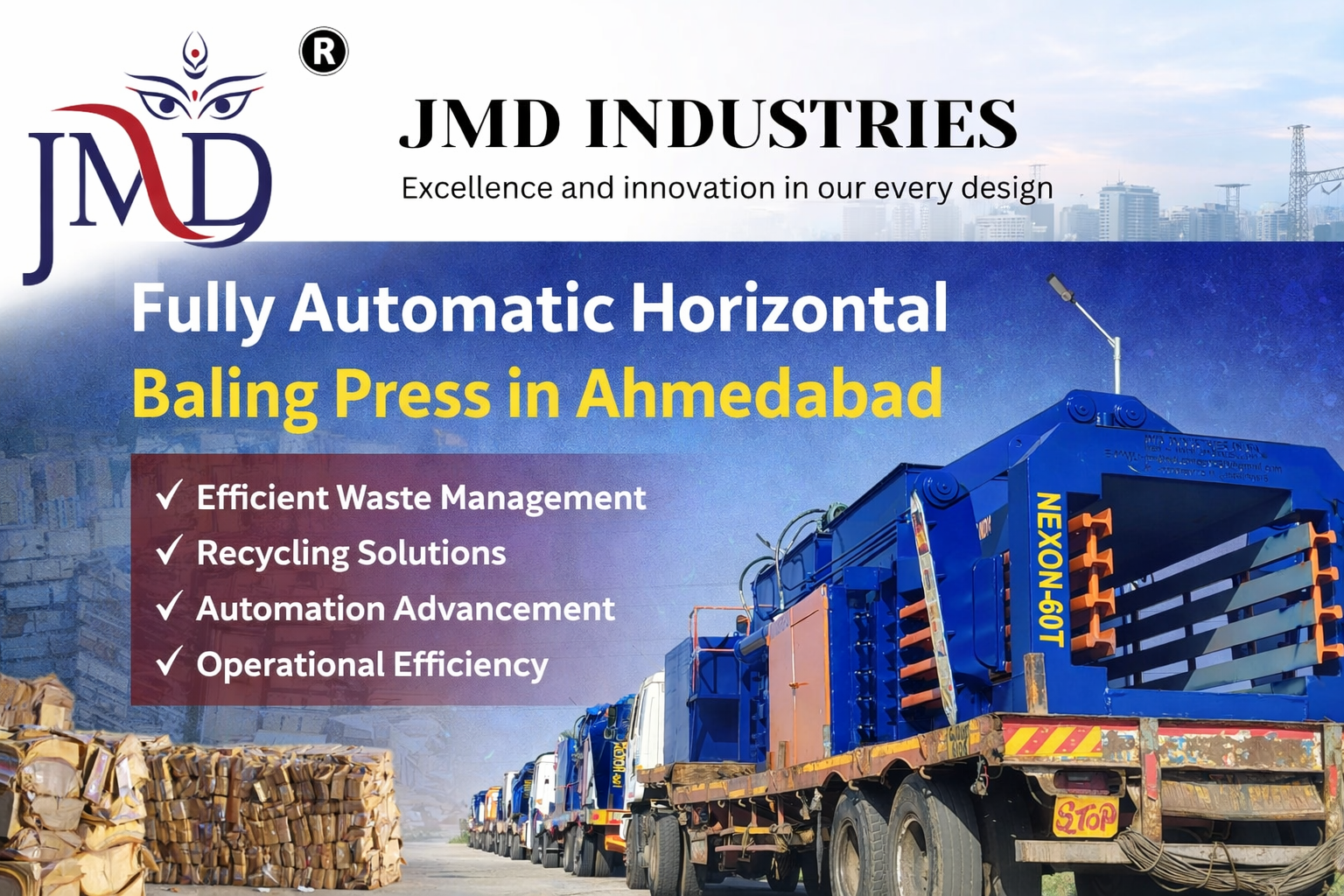

Efficient waste management has become a critical operational requirement for industries, warehouses, recycling facilities, and municipal bodies. With rising waste volumes and stricter environmental regulations, organizations are increasingly adopting automated systems that improve material handling efficiency while supporting long-term sustainability goals. One such solution is the fully automatic horizontal baling press, a machine engineered for continuous, high-capacity waste compaction with minimal human intervention.
In Ahmedabad, a major industrial and recycling hub of Gujarat, demand for fully automatic horizontal baling press machines has increased steadily across sectors such as paper recycling, plastic processing, logistics, manufacturing, and organized waste management. These machines are now considered essential infrastructure for operations handling large volumes of recyclable materials.
A fully automatic horizontal baling press is an industrial system used to compress loose recyclable materials into dense, uniform bales. Unlike manual or semi-automatic balers, this machine automates feeding, compaction, bale tying, and ejection, enabling uninterrupted operation and consistent output quality.
The horizontal configuration allows continuous material feeding, making the system suitable for high-throughput environments. Materials such as cardboard, mixed paper, newspapers, PET bottles, plastic films, and packaging waste are compacted into standardized bales that are easier to store, transport, and recycle.
In industrial cities like Ahmedabad, where recycling facilities manage large daily volumes, fully automatic horizontal balers help reduce reliance on manual labor, enhance workplace safety, and optimize floor space utilization.
Traditional waste handling methods often involve repeated manual handling, inefficient storage, and inconsistent output. A fully automatic horizontal baling press streamlines this process by integrating automation into every stage of bale formation.
Material is fed into the system manually, through conveyors, or via automated feeding arrangements. The hydraulic ram compresses the material inside the baling chamber to a predefined density. Once the bale reaches the required size, the automatic tying mechanism secures it using wires or straps, and the finished bale is ejected without interrupting the next cycle.
This continuous workflow improves processing speed while maintaining uniform bale weight and density. For businesses operating in Ahmedabad's competitive industrial environment, such efficiency contributes directly to reduced downtime and improved resource utilization.
Fully automatic horizontal baling presses are widely used across multiple industries due to their versatility and ability to handle different waste streams. Common application areas include:
In Ahmedabad and surrounding industrial regions, these machines support organized recycling systems by enabling efficient segregation, compaction, and downstream transportation.
The increasing adoption of fully automatic baling systems is driven by their operational and environmental benefits. These machines are designed to address modern waste management challenges with long-term efficiency.
Automation significantly reduces manual labor requirements, improving workplace safety and lowering dependency on skilled operators. Consistent bale quality is maintained throughout operations, which is critical for recyclers and material buyers who require uniform specifications.
Space optimization is another key advantage. By converting loose waste into compact bales, facilities can store higher volumes within limited floor space, a common constraint in urban industrial zones like Ahmedabad.
Energy-efficient hydraulic systems contribute to lower operating costs, while robust machine construction ensures long service life under continuous industrial use.
Ahmedabad has developed into a major industrial center in western India, supporting manufacturing, packaging, textile, pharmaceutical, and recycling sectors. The city's infrastructure, skilled workforce, and connectivity to transport corridors make it an ideal location for waste processing and recycling operations.
With growing regulatory emphasis on waste segregation, recycling, and landfill reduction, industries in Ahmedabad are increasingly investing in automated baling solutions. Fully automatic horizontal baling presses help businesses align with environmental compliance requirements while improving operational efficiency.
The presence of organized recycling markets across Gujarat further increases the value of well-compacted, standardized bales, positioning automated balers as a strategic operational investment.
A reliable fully automatic horizontal baling press is defined by engineering precision and component durability. The hydraulic system must deliver consistent pressure to maintain uniform bale density, while the structural frame should withstand continuous high-load operation.
Advanced control panels allow operators to monitor system performance, adjust bale parameters, and manage safety interlocks. Automatic tying systems reduce cycle time and eliminate manual intervention during bale formation.
Design emphasis on maintenance accessibility ensures routine inspections and servicing can be carried out efficiently. For industrial users in Ahmedabad, where production continuity is critical, these engineering aspects play an important role in equipment selection.
Selecting the appropriate baling press requires careful assessment of operational requirements and material characteristics. Key factors to consider include:
For businesses operating within Gujarat's industrial clusters, aligning equipment capacity with long-term operational planning is essential to avoid bottlenecks or premature upgrades.
Fully automatic horizontal baling presses are built for continuous operation, but routine maintenance remains essential for consistent performance. Preventive maintenance typically includes hydraulic oil inspection, lubrication of moving parts, checking tying mechanisms, and monitoring electrical systems.
Well-maintained machines deliver stable output quality, minimize unexpected downtime, and extend service life. Industrial users in Ahmedabad often prioritize machines with accessible components and reliable local service support to ensure uninterrupted operations.
Automation also reduces operator dependency, contributing to safer working environments and predictable performance across multiple shifts.
Beyond operational efficiency, fully automatic horizontal baling presses support sustainable waste management practices. By compacting recyclable materials, these machines reduce transportation frequency, lowering fuel consumption and emissions.
Improved bale formation enhances recycling efficiency by simplifying material handling at downstream facilities. This supports circular economy initiatives and helps industries reduce their environmental footprint.
In a growing industrial city like Ahmedabad, automated baling systems contribute to cleaner operations and responsible waste management.
Advancements in waste management technology continue to focus on higher automation, smarter controls, and improved energy efficiency. Modern fully automatic horizontal baling presses increasingly feature programmable logic controllers, remote monitoring, and performance data tracking.
These developments enable businesses to optimize operations, predict maintenance requirements, and integrate baling systems into broader smart factory or waste management frameworks. As industries in Ahmedabad adopt digital transformation strategies, automated baling technology will remain a key component of efficient material handling systems.
A fully automatic horizontal baling press is a critical investment for industries and recycling operations seeking efficient, scalable, and sustainable waste management solutions. In Ahmedabad, where industrial expansion and environmental responsibility are closely linked, these machines enable organizations to handle large waste volumes with precision, safety, and consistency.
By automating the baling process, businesses can improve operational efficiency, reduce manual dependency, optimize space utilization, and actively support recycling initiatives. As waste management standards continue to evolve, fully automatic horizontal baling presses will remain a core component of modern industrial infrastructure.
These machines handle paper, cardboard, mixed paper, newspapers, PET bottles, plastic films, and various packaging wastes generated by industrial and commercial operations.
Yes, fully automatic horizontal balers are designed for high-volume, continuous operation using robust hydraulic systems and automated controls.
Automation eliminates manual feeding, tying, and bale ejection, allowing fewer operators to manage the entire baling process safely and efficiently.
Horizontal balers support continuous feeding and higher throughput, making them suitable for facilities handling large daily waste volumes.
Hydraulic pressure, chamber design, material type, and machine calibration all impact bale density and uniformity.
By improving waste compaction and recyclability, baling presses help reduce landfill dependency and support regulatory compliance.
JMD INDUSTRIES | All Rights Reserved.