
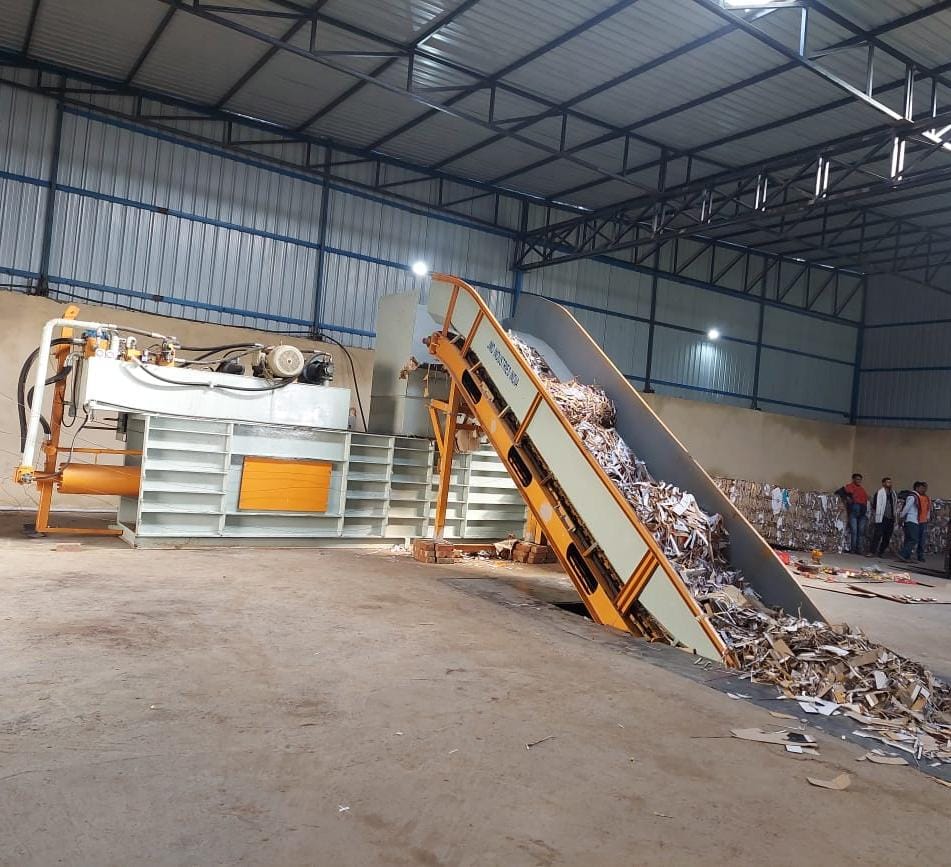
Industrial Baler Price
Find the right industrial baler price for your plant without surprises. This guide explains typical price bands in India, what drives costs up or down, and how to calculate the true total cost of ownership (TCO) before you invest.
Quick Overview: What Affects Industrial Baler Pricing?
Pricing varies by bale size, throughput (TPH or bales/hour), automation level, build quality, hydraulic tonnage, power pack, safety features, and after-sales support. Transport, installation and GST further influence your on-floor cost.
Typical Price Bands in India (Indicative)
- Entry Vertical Balers (light–medium duty): ~₹2.5–6 lakh — compact footprint, manual tying, ideal for retail/warehouses.
- Heavy Vertical / Small Horizontal: ~₹6–12 lakh — higher compression, larger bale size, faster cycles.
- Semi-Automatic Horizontal Balers: ~₹12–35 lakh — hydraulic door tying, conveyors optional, suited for steady volumes.
- Fully Automatic Channel Balers: ~₹40 lakh–₹2.5 crore+ — auto-feed, auto-tying, conveyors, rufflers; designed for high-volume MRFs.
Note: Prices are indicative ranges for budgeting. Final quotes depend on specs, options and site conditions.
Key Cost Drivers You Should Compare
- Compression Tonnage & Motor HP — impacts density, cycle time, energy cost.
- Bale Size & Weight — determines logistics savings and revenue per bale.
- Automation Level — conveyors, rams, auto-tying, PLC/HMI add cost but reduce labor.
- Build & Safety — steel thickness, wear plates, interlocks, safe guards.
- Consumables & Spares — wire/strap type, seal kits, filters, oil volume.
- Service Network — response times, AMC cost, warranty coverage.
How to Budget the Total Cost (TCO)
- Capex: machine price + freight + installation + electricals + civil/space prep.
- Opex: power consumption (kWh), wires/straps, operator hours, routine maintenance.
- Savings/Uplift: reduced hauling trips, higher bale density, better scrap realisation.
- Payback: divide net monthly savings by capex to estimate months to break even.
Ways to Reduce Your Final Price
- Right-size the baler to your real throughput instead of over-specifying tonnage.
- Choose semi-automatic today but plan provisions for future conveyor/auto-tying.
- Standardise bale dimensions to lower consumable and logistics cost.
- Opt for AMC and operator training to protect warranty and uptime.
- Bundle accessories (conveyor, ruffler, bin lifter) for better overall commercial.
When Does a Premium Baler Pay Off?
For continuous multi-shift operations, a higher-efficiency hydraulic system, faster cycle times, and auto-tying can slash labor per tonne and power per bale—often yielding a shorter payback despite the higher sticker price.
Maintenance & Buying Tips
- Ask for power audit data (kWh/tonne) and real cycle time at your material density.
- Verify frame thickness, wear-plate protection and cylinder specs for duty cycle.
- Check access for cleaning, oil filtration, and safe isolation during maintenance.
- Confirm wire/strap availability and typical monthly consumption at target output.
- Insist on commissioning support, operator training, and spare kit with delivery.
FAQs – Industrial Baler Price
1. Why do quotes for the same tonnage vary so much?
+
Differences in steel thickness, hydraulics, valves, cycle time, safety interlocks, automation and warranty terms create large price gaps even at similar tonnage.
2. What minimum specs should I insist on?
+
Clear bale size/weight target, verified cycle time at your material, motor HP, pump flow, safety interlocks, emergency stops, and reliable after-sales commitments.
3. How can I compare energy costs between models?
+
Request kWh per bale or per tonne at your feedstock. Factor electricity rate and operating hours to estimate monthly bills accurately.
4. Do I need a conveyor or bin lifter from day one?
+
Not always. Start manual and upgrade later—ensure the baler design has mechanical/electrical provisions for future integration to save rework costs.
5. Can I get an exact price now?
+
Exact pricing depends on your throughput, material mix, bale size, and automation needs. Share these details for a tailored quotation and payback estimate.
Contact Details
Talk to our specialists today for tailored solutions and fast assistance.
Company:
Jmd Baler
WhatsApp:
Chat on WhatsApp
Email:
jmdindustries9412@gmail.com
Website:
www.jmdbaler.com
Address:
PLOT NO 71/72 Avdhesh industrial hub, Bhavda - Bakrol, Bhavda patiya, Ahmedabad, Gujarat.