
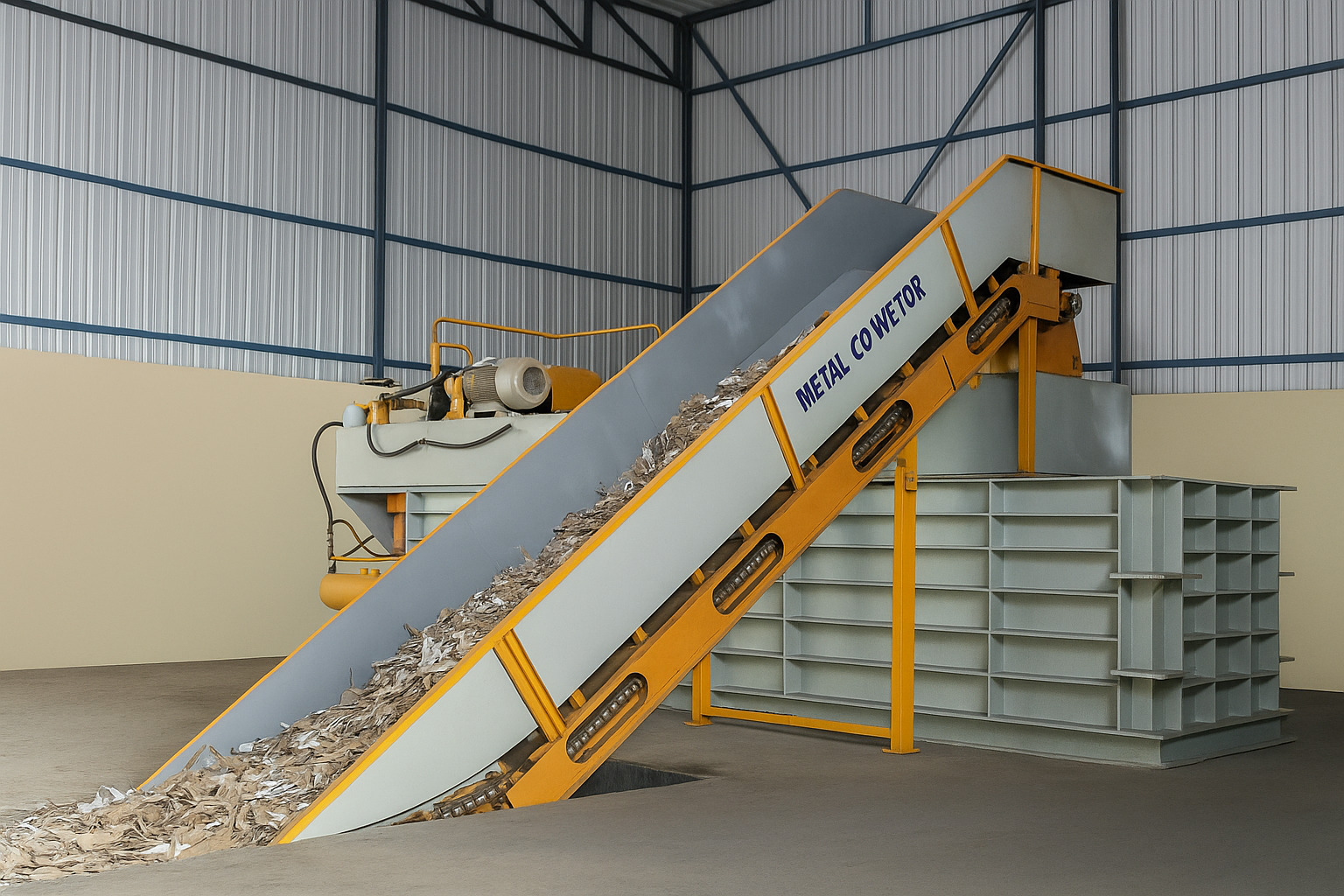
Industrial Waste Paper Baling Machine – Heavy-Duty Solutions for OCC & Mixed Paper
Searching for a robust industrial waste paper baling machine to consolidate OCC cartons, trim waste, magazines, or mixed paper at scale? This guide explains machine types, selection criteria, throughput planning, and ROI checkpoints so MRFs, recycling plants, printers, and logistics hubs can choose a baler that runs reliably round-the-clock with low cost per bale.
What Counts as “Industrial” in Paper Baling
Industrial balers are engineered for continuous duty, higher compression forces, and automated handling. Look for heavy-gauge frames, oversized cylinders, efficient power packs, and options like conveyor feeding and auto tying to sustain 3–25+ TPD lines while maintaining consistent bale density for better buyer realization.
Types of Industrial Paper Balers
- Vertical Baling Press (10–60T): Compact footprint; ideal for warehouses & unit-level consolidation. Manual tying; 80–250 kg bales.
- Semi-Automatic Horizontal: Hopper feed with hydraulic bale ejector. Higher throughput; great for printers & packaging units.
- Fully-Automatic Horizontal: Conveyor infeed + auto tying for uninterrupted operation at MRFs and high-volume recyclers.
- Channel/Closed-Door Horizontal: Delivers dense, uniform bales; supports continuous lines and standardized bale sizes.
Industrial-Grade Features to Prioritize
- High-pressure hydraulics with quality pumps and heat-managed oil circuits for long service life.
- Wear liners, hardfacing at friction points, and reinforced chambers to maintain bale density.
- PLC interlocks, door/guard safety, e-stops, and overload protection for safe 24/7 operation.
- Auto bale length control, bale counter, and ejector sequences to standardize output.
- Energy-efficient motors/VFDs or soft starters to reduce kWh per ton and heat load.
Where Industrial Balers Are Used
- Material Recovery Facilities (MRFs): Continuous mixed paper/OCC streams needing conveyor feed and auto tying.
- Printers & Corrugators: Trim waste, reel ends, and cartons with hopper infeed for higher productivity.
- E-commerce & Warehousing: Centralized OCC consolidation to cut storage and transport costs.
- Municipal & Institutional Programs: Sorted collection from campuses, offices, and markets into trade-ready bales.
Benefits of Going Industrial
- Higher throughput with consistent bale density for better buyer pricing.
- Lower labor per ton via conveyor infeed, auto eject, and auto tying options.
- Improved safety & uptime with robust guarding, interlocks, and reliable hydraulics.
- Reduced logistics cost—dense, uniform bales optimize truck loads and storage.
- Predictable OPEX through energy-efficient power packs and planned maintenance.
Budget & Sizing Pointers (Indicative)
Vertical (10–30T): Entry industrial consolidation — capex friendly; suited to 0.5–2 TPD streams.
Semi-Auto Horizontal (30–60T): 3–8 TPD lines with hopper feed and hydraulic ejector.
Fully-Auto Horizontal (60–120T+): 10–25+ TPD continuous duty with conveyor and auto tying.
Note: Final price depends on tonnage, steel thickness, bale size, motor HP, controls, liners, and service/warranty scope.
Procurement Checklist
- Ask for kWh/ton at rated throughput and verify on a live line.
- Inspect weld quality, chamber reinforcement, and plate thickness at high-load areas.
- Confirm availability of wear parts (seals, hoses, liners, knives) for 12–18 months.
- Review safety devices: interlocks, guards, e-stops, pressure relief, and alarms.
- Include AMC & response SLAs with training and operating SOPs in the quote.
FAQs – Industrial Waste Paper Baling Machine
1. Which baler is best for 10–15 TPD mixed paper?
+
A fully-automatic horizontal with conveyor infeed and auto tying is recommended to sustain continuous duty and consistent bale density.
2. What bale size should I target?
+
Standard widths around 800–1000 mm are widely accepted by buyers. Choose a size that optimizes truck loading and your buyer’s baler specs.
3. How do I cut operating costs?
+
Use energy-efficient motors/VFDs, maintain oil quality, plan material flow to minimize idle time, and standardize preventive maintenance.
4. Can one machine handle OCC plus magazines/newspapers?
+
Yes—specify bale density and chamber reinforcement; use correct tying media and feed controls to handle varying bulk densities consistently.
5. What details are needed for a quote?
+
Daily TPD, material mix, target bale size/weight, available power, space constraints, automation needs (conveyor/auto tying), and service expectations.
Contact Details
Talk to our specialists today for tailored solutions and fast assistance.
Company:
Jmd Baler
WhatsApp:
Chat on WhatsApp
Email:
jmdindustries9412@gmail.com
Website:
www.jmdbaler.com
Address:
PLOT NO 71/72 Avdhesh industrial hub, Bhavda - Bakrol, Bhavda patiya, Ahmedabad, Gujarat.