
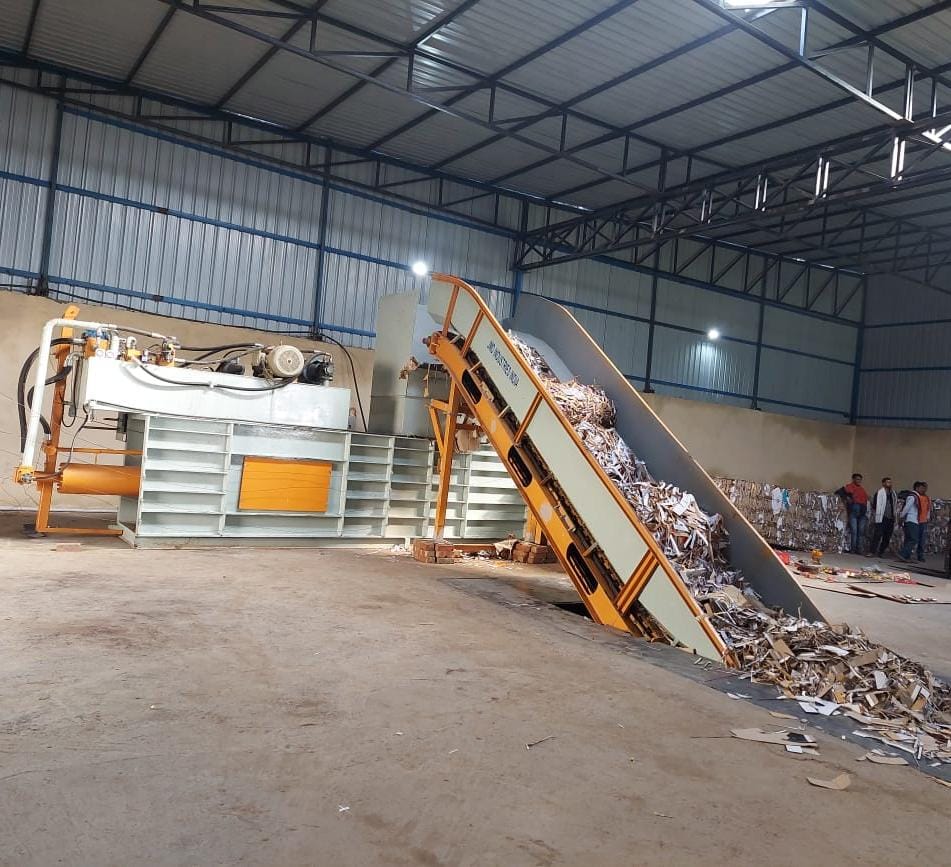
Introduction to Hydraulic Baling Press Machine for Waste Paper
Searching for a reliable Hydraulic Baling Press Machine for Waste Paper? India’s recyclers, printers, warehouses, and e-commerce hubs trust heavy-duty balers to compress OCC, cartons, and mixed office paper into dense, transport-ready bales. This page explains types, features, applications, and maintenance tips to help you choose the right waste-paper baler for throughput, bale density, and operating cost.
Why Choose a Hydraulic Waste Paper Baler
A modern hydraulic baler cuts volume by up to 80–90%, reduces storage and freight costs, and streamlines housekeeping. With consistent compression force, interlocked safety guards, and easy ejection, you get uniform bale weight and faster truck loading—all while improving material recovery value and facility safety.
Types of Hydraulic Waste Paper Balers
- Vertical Baling Press: Compact footprint for retail stores, print shops, and small warehouses; simple operation and lower capex.
- Horizontal Baling Press: Higher throughput for logistics parks and MRFs; continuous feeding via conveyors.
- Semi-Automatic Horizontal: Manual tying with powered ejection; balanced option for mid-scale recyclers.
- Fully Automatic Channel Baler: Auto tying and high cycle rates—ideal for high-volume OCC lines.
Key Features for Waste Paper Baling
- High-pressure hydraulic powerpacks for dense, uniform bales that optimize freight.
- Heavy-gauge frames, wear plates, and shear blades suited to cardboard/OCC.
- Safety interlocks, e-stops, and overload protection for compliant operation.
- Optimized oil circuits and motors for lower kWh/ton and cooler running.
- Custom bale size options, tying with steel or PP straps, and easy bale ejection.
Industries & Applications
- Recycling centers and MRFs consolidating corrugated cartons, newspapers, and mixed paper streams.
- E-commerce and 3PL warehouses compacting daily packaging waste for back-haul monetization.
- Print and packaging units managing trimmings, offcuts, and rejected stacks efficiently.
- Retail chains, supermarkets, and malls reducing store-room clutter and haulage costs.
Benefits of Hydraulic Baling for Waste Paper
- Up to 80–90% volume reduction and fewer pickups lead to lower logistics spend.
- Consistent bale density improves buyer acceptance and revenue per ton.
- Cleaner, safer floors with faster housekeeping and fire-risk reduction.
- Local service and spare availability minimize downtime and lifecycle costs.
- Scalable—from single vertical balers to auto-tying horizontal lines.
Selection Guide: Match Baler to Throughput
For ≤1 ton/day, start with a vertical 30–60 ton press. For 1–8 tons/day, consider semi-automatic horizontals with conveyor feed. Above that, a fully automatic channel baler with auto tying delivers the best OEE and operator safety with minimal manual touchpoints.
Maintenance & Operational Tips
- Check hydraulic oil level and filters every 500 hours; replace per OEM schedule.
- Grease guide rails and pivot points monthly to prevent uneven wear.
- Inspect strapping heads, shear blades, and door seals; tighten fasteners routinely.
- Train operators on safe loading, bale tying, and lock-out/tag-out procedures.
- Stock critical consumables (oil, filters, straps, seals) to avoid avoidable downtime.
FAQs – Hydraulic Baling Press Machine for Waste Paper
1. Which baler is best for OCC and corrugated cartons?
+
For low volumes, a vertical baler is economical. For continuous feed and higher TPH, choose a horizontal semi-automatic or fully automatic channel baler.
2. What bale sizes and weights are typical?
+
Common bales are ~900×600×900 mm in verticals (80–150 kg) and larger rectangular bales in horizontals (250–450+ kg), customizable per buyer specs.
3. Can one machine handle mixed paper with plastics?
+
Yes, but pre-sorting improves density and bale quality. Shear blades and wear liners help when occasional plastics or soft contaminants are present.
4. How much power does a baler consume?
+
Depends on pump size and duty cycle; energy-efficient powerpacks and auto-idle reduce kWh/ton. Ask for a load curve with your quotation.
5. Do suppliers provide installation and AMC?
+
Leading Indian suppliers offer on-site installation, operator training, warranty, and optional annual maintenance contracts (AMC) for assured uptime.
Contact Details
Talk to our specialists today for tailored solutions and fast assistance.
Company:
Jmd Baler
WhatsApp:
Chat on WhatsApp
Email:
jmdindustries9412@gmail.com
Website:
www.jmdbaler.com
Address:
PLOT NO 71/72 Avdhesh industrial hub, Bhavda - Bakrol, Bhavda patiya, Ahmedabad, Gujarat.