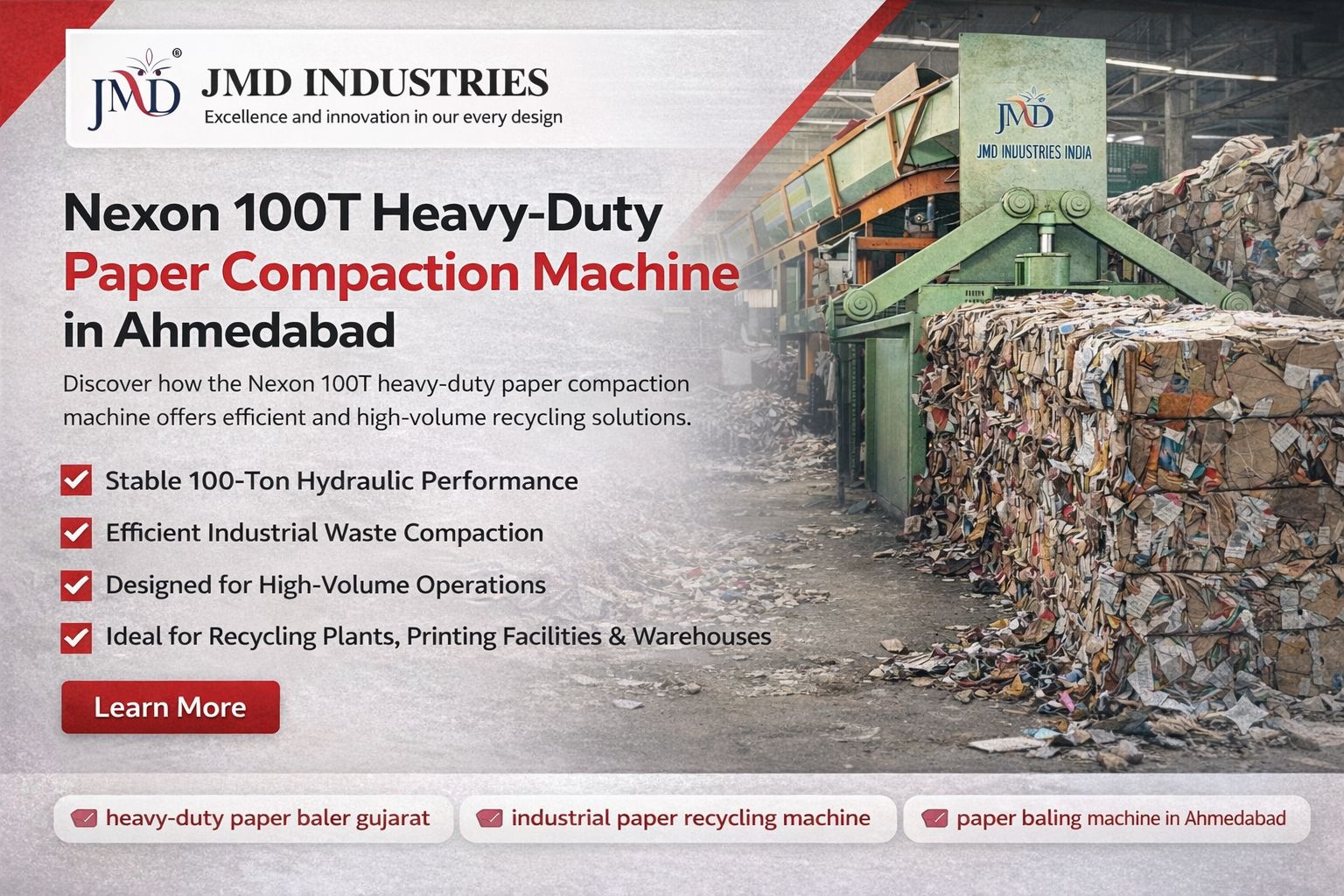

Effective paper waste management has become a core operational requirement for recycling units, printing facilities, paper mills, and large commercial operations. In this context, the Nexon 100T Heavy-Duty Paper Compaction Machine in Ahmedabad is designed to manage high paper volumes with consistency, safety, and long-term operational stability. This article explains the machine's working principle, applications, engineering considerations, and its relevance for industrial operations across Ahmedabad and Gujarat.
JMD Industries is an Indian manufacturer specializing in horizontal baling press machines for industrial waste management and recycling applications. The company designs equipment for paper, mixed paper, newspaper, and PET bottle recycling. With an engineering-focused approach, JMD Industries develops machines that support efficient compaction, reduced manual handling, and dependable performance in demanding industrial environments.
The Nexon 100T is a hydraulic paper baling machine engineered for continuous, high-load operation. It compresses large quantities of loose paper waste into dense, uniform bales that are easier to store, transport, and process further. Operating with a 100-ton pressing force, the machine is suited for facilities where output consistency and structural reliability are essential.
This paper compaction system is typically used where manual or low-capacity baling methods are no longer practical due to increasing waste volumes. Its structural framework, hydraulic configuration, and control layout are intended for sustained industrial workflows rather than intermittent use.
Uncompacted paper waste occupies significant storage space and increases handling complexity. In industrial areas such as Ahmedabad, where floor space utilization and logistics efficiency directly affect operating costs, compaction plays a functional role rather than a secondary one.
By converting loose paper into standardized bales, facilities can improve internal material flow and maintain better control over waste handling. Compaction also supports recycling supply chains by delivering uniform bale sizes that align with downstream processing requirements.
The Nexon 100T paper compaction machine operates by applying controlled hydraulic pressure within a reinforced compression chamber. Paper waste is loaded through a wide feed opening, allowing bulk material to be processed with minimal pre-sorting.
Once the chamber reaches its loading capacity, the hydraulic ram compresses the paper to the required density. After compaction, the bale is secured using wire lanes and ejected automatically for storage or transport. This sequence supports repeatable cycles and enables continuous operation with limited operator intervention.
Several integrated features influence the machine's performance and operational stability:
These features are designed to reduce interruptions and maintain predictable daily output.
From an engineering standpoint, a heavy-duty paper baling machine must withstand both mechanical stress and continuous duty cycles. The Nexon 100T is constructed using high-grade structural steel to maintain integrity under repeated compression loads.
The hydraulic power pack is sized for stable pressure delivery, while adequate oil reservoir capacity supports thermal stability during extended operation. Component accessibility is also considered, as ease of maintenance directly affects machine uptime in industrial facilities.
Paper compaction machines in this capacity range are commonly deployed where waste generation is continuous and volume-intensive. Typical applications include:
These environments rely on consistent bale weight and size to maintain efficiency throughout the recycling process.
Ahmedabad is one of Gujarat's key industrial centers, with strong activity across textiles, packaging, printing, and logistics sectors. These industries generate substantial volumes of recyclable paper waste daily. A heavy-duty paper compaction machine in Ahmedabad addresses local operational challenges such as limited storage space, high waste throughput, and the need for efficient material handling.
Industrial estates around the city benefit from centralized waste processing systems, where standardized paper bales simplify transportation to recycling units across Gujarat and neighboring regions.
Integrating a 100-ton paper baler into an existing facility requires alignment with material flow and labor practices. The Nexon 100T supports conveyor-based feeding systems, enabling automated or semi-automated workflows.
By reducing manual loading and bale handling, facilities can allocate labor toward monitoring, inspection, and quality control rather than repetitive physical tasks. This approach supports both productivity and workplace safety.
Safety is a fundamental requirement in heavy machinery environments. The Nexon 100T incorporates safety door interlocks and emergency stop systems that limit operator exposure during compression cycles. These mechanisms support compliance with standard industrial safety practices without adding unnecessary complexity.
While proper training and routine inspections remain essential, built-in safety features provide an additional layer of operational control.
Maintenance directly influences the lifecycle performance of a paper compaction machine. Access to hydraulic components, electrical panels, and wear parts simplifies routine inspection and servicing.
The Nexon 100T is structured to allow maintenance tasks without extensive disassembly. Consistent oil quality management, seal inspection, and alignment checks help sustain pressing efficiency and reduce unplanned downtime.
Although paper baling machines are industrial tools, they contribute indirectly to environmental management. Efficient compaction reduces the number of transport trips required for recycling, lowering fuel consumption and handling-related emissions.
Dense, uniform bales also help preserve material quality during storage and transport, supporting higher recycling recovery rates. In this way, paper compaction forms part of a broader waste reduction strategy.
Selecting a 100-ton paper baling machine depends on waste volume, operating hours, and future scalability. Facilities processing several tons of paper per hour typically require higher-capacity systems to avoid material backlogs.
Before installation, it is important to evaluate available floor space, power infrastructure, and compatibility with conveyors or sorting lines. Proper capacity planning ensures the machine operates within optimal parameters rather than under continuous peak load.
Horizontal baling technology is widely preferred in large-scale operations due to its ability to handle continuous material input. Unlike vertical balers, horizontal systems support automated feeding and consistent output without frequent stoppages.
The Nexon 100T follows this design approach, making it suitable for operations where paper waste is generated steadily throughout the working day.
As recycling standards and compliance requirements continue to evolve, demand for reliable paper compaction equipment is expected to increase. Industrial hubs such as Ahmedabad are likely to see greater adoption of automated waste handling systems focused on efficiency and regulatory alignment.
Machines like the Nexon 100T represent a structured response to these requirements, supporting long-term recycling infrastructure rather than short-term capacity solutions.
The Nexon 100T Heavy-Duty Paper Compaction Machine in Ahmedabad addresses the operational requirements of high-volume paper waste management in industrial environments. Its hydraulic capacity, structural design, and workflow compatibility make it suitable for recycling and commercial facilities that require consistent, reliable compaction. By enabling efficient waste handling and standardized bale output, the machine integrates effectively into recycling and sustainability frameworks across Ahmedabad and the wider Gujarat industrial region.
JMD INDUSTRIES | All Rights Reserved.