Call Us

+91 8866859465

Email Us

jmdindustries9412@gmail.com

White Paper Press Baling Machine Price

White Paper Press Baling Machine Price

Planning to buy a white paper press baling machine and want clear pricing guidance? This page explains the cost drivers, specification choices, and total cost of ownership so you can budget accurately and avoid hidden expenses. For model suggestions and a formal quotation, connect with Jmd Baler.


How Pricing Is Determined

Pricing varies with bale size and density requirements, motor & pump capacity, hydraulic tonnage, feed style (manual/auto), chamber build, controls, and optional add-ons like conveyors or cross-strapping. Freight, GST, and on-site commissioning are billed as per location. Choosing the right configuration ensures optimum bale weight, faster turnaround, and the lowest life-cycle cost per ton of compacted paper.

Typical Configurations for White Paper Baling

  • Vertical Paper Baler — economical footprint; ideal for print houses, offices, and warehouses producing 0.5–4 tons/day.
  • Horizontal Closed-Door Baler — higher throughput with manual tying; suited for 3–12 tons/day with consistent bale dimensions.
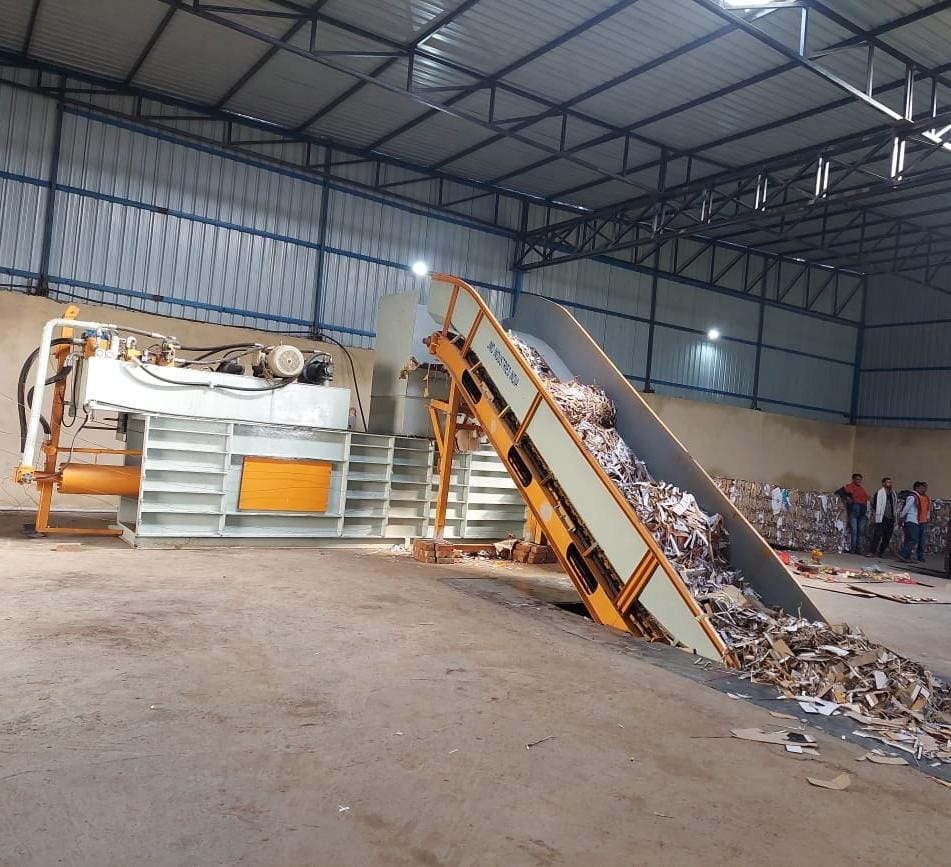
  • Semi-Automatic Horizontal Baler — hopper fed with hydraulic eject; balances price and productivity for 8–20 tons/day.
  • Fully Automatic Channel Baler — continuous feed, auto tying; best for 20+ tons/day and centralized MRF/recycling facilities.

Key Specification Factors Impacting Price

  • Hydraulic Tonnage & Motor HP — higher compression and faster cycles increase cost but improve bale density and output.
  • Chamber Size & Bale Dimensions — larger chambers deliver heavier bales, reducing handling/logistics cost per ton.
  • Structure & Wear Parts — heavy-gauge steel, replaceable liners, and quality seals lower long-term maintenance expense.
  • Controls & Safety — PLC/HMI, auto cycle, interlocks, and sensors add convenience and compliance value.
  • Feeding & Tying Options — conveyors, cyclone ducts, and cross-strapping kits influence both CAPEX and productivity.

What You Get for Your Budget (Indicative)

  • Entry Segment: vertical balers for white paper reams, cuttings, and office waste; compact size, manual tying, low power need.
  • Mid Segment: horizontal closed-door or semi-auto balers; faster cycles, bigger bales, optional conveyors for steady feed.
  • High Output: fully automatic channel balers; auto tying, continuous operation, and integration with shredders/sortation lines.
  • Total Cost: evaluate per-ton cost including energy, consumables, manpower, annual service, and downtime risk—not only CAPEX.

Benefits of Baling White Paper

  • Higher Realization: dense, uniform bales fetch better prices from recyclers with reduced transport frequency.
  • Space & Hygiene: compaction keeps shop floors clean, frees storage area, and improves safety.
  • Productivity: faster loading, controlled cycles, and predictable bale weights streamline dispatch planning.
  • Compliance: safer handling and tidy material movement support audit-ready housekeeping standards.

Buying Tips to Optimize Price vs. Performance

  • Baseline Your Load: record daily/weekly paper volumes and target bale weight—this decides chamber size and tonnage.
  • Check Power & Layout: confirm electrical capacity, floor space, aisle widths, and bale storage/dispatch flow.
  • Ask for Density Proofs: request sample bales or client references matching your paper type and moisture profile.
  • Evaluate Spares & AMC: prefer suppliers stocking seals, valves, and wear plates locally with defined SLA.
  • Future-Proofing: consider conveyor feed and auto tying readiness if your volumes are likely to grow in 6–18 months.

FAQs — White Paper Press Baling Machine Price

1. Why do prices vary so much between models? +
Differences in hydraulic tonnage, motor HP, chamber size, structure thickness, and automation (conveyor/auto-tying/PLC) create distinct cost tiers and performance outcomes.
2. How do I estimate the right capacity for white paper? +
Map your daily tonnage and desired bale weight. For up to ~4 TPD, a vertical often suffices; beyond that, horizontal/semi-auto provides better throughput and labor efficiency.
3. What add-ons affect the final quote? +
Conveyors, ruffler/cyclone feed, cross-strapping, remote diagnostics, bale ejectors, and custom guards impact both pricing and productivity gains.
4. What about warranty and service costs? +
Standard warranties cover manufacturing defects; AMCs include preventive visits and prioritized spares. Clarify response times and included consumables in writing.
5. Can I upgrade later without replacing the machine? +
Many platforms support conveyor integration, higher HP motors, and controls upgrades. Discuss upgrade paths during purchase to plan cabling, space, and safety interlocks.

Contact Details

Talk to our specialists today for tailored solutions and fast assistance.

Company: Jmd Baler
WhatsApp: Chat on WhatsApp
Website: www.jmdbaler.com
Address: PLOT NO 71/72 Avdhesh industrial hub, Bhavda - Bakrol, Bhavda patiya, Ahmedabad, Gujarat.